Marketers, others reject Dangote fuel pricing in dollars
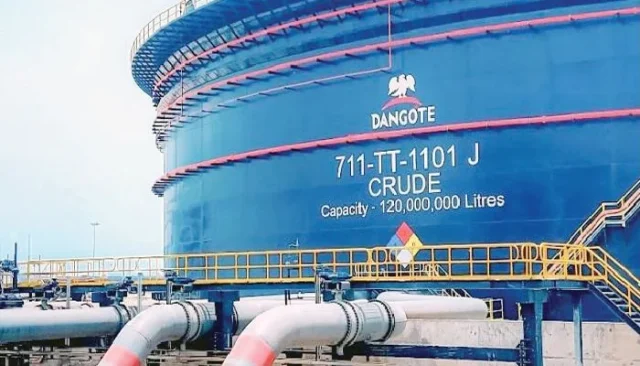
Independent petroleum marketers and energy experts have rejected the Dangote Petroleum Refinery’s decision to introduce United States dollar-denominated pricing for petroleum products, warning that the move could worsen foreign exchange pressures and trigger fresh instability in the downstream sector.
The stakeholders, who spoke in separate interviews with The PUNCH on Tuesday, argued that while the refinery, as a private business, had the right to make commercial decisions, pricing locally consumed petroleum products in dollars could have wider economic implications
The Petroleum Products Retail Outlets Owners Association of Nigeria faulted the development, saying dollar-based fuel transactions could gradually push the country towards a dollarised economy and undermine efforts to stabilise the petroleum market.
The Independent Petroleum Marketers Association of Nigeria, on its part, urged President Bola Tinubu to urgently intervene and ensure the continuation of the crude-for-naira arrangement, warning that tying fuel prices to the dollar could increase pump price volatility.
Energy experts, however, offered divergent views on the policy, with some arguing that the refinery’s decision was a commercial response to foreign exchange risks associated with crude procurement and refinery operations, while others insisted that domestic fuel sales should remain anchored on the naira as Nigeria’s legal tender.
The controversy followed Dangote Petroleum Refinery’s decision to quote ex-depot prices for Premium Motor Spirit, Automotive Gas Oil and aviation fuel in United States dollars for gantry and coastal transactions.
In a mail to marketers on Monday, it said, “Following our email on the 9th of July, 2026, regarding the transition from Naira to United States Dollars, please note that all issued Naira Coastal and Gantry PFIs/Deal Recaps are now invalid, and no payments should be made against them.”
Following the announcement, depot owners across major petroleum hubs began adjusting their loading prices as marketers moved to factor in possible changes in replacement costs.
Fuel pricing according to petroleumprice.ng showed that petrol prices increased by as much as N113 per litre at some depots, while diesel prices rose by up to N150 per litre in some locations.
The development has renewed debate over Nigeria’s petroleum deregulation policy, with stakeholders divided over whether the dollar pricing model represents a legitimate business strategy to manage foreign exchange risks or a move that could worsen pressure on domestic consumers.
The National President of PETROAN, Billy Gillis-Harry, described the decision as a development that could gradually push Nigeria towards a dollarised economy if not properly managed.
Speaking with one of our correspondents, Gillis-Harry faulted the decision by the Dangote Petroleum Refinery to sell petrol in United States dollars, warning that the move could effectively dollarise the Nigerian economy and further destabilise the downstream petroleum sector.
While acknowledging Dangote Refinery’s contribution to Nigeria’s energy security, he argued that commercial decisions by a major market player must align with national economic objectives.
“This will turn Nigeria into a dollarised economy. That is the meaning, and that’s why we are saying that some of these decisions, in as much as it’s a private company that has the right to regulate the economy to do what it wants, we still have regulations, not just of price, but of values that should be able to stabilise our economy,” he said.
Gillis-Harry added, “At the end of the day, I think everything has been interrogated properly, and all the stakeholders will then take a decision. Because we cannot have one player, that is the refiner waking up today to change price; tomorrow it increases it; another day it does something else; and suddenly it wakes up and says everybody who had paid naira in his company is no longer valid.”
Gillis-Harry argued that marketers purchasing petrol in dollars would inevitably come under pressure to pass the burden to consumers. “It is like saying those who buy from Dangote in dollars should also sell in dollars to the masses. But we are not going to do that,” he said.
The PETROAN president stressed that the association would continue sourcing products from all available suppliers while urging the Nigerian National Petroleum Company Limited to revive the country’s refineries to promote competition.
“PETROAN will continue to patronise Dangote, patronise imported products, and keep encouraging NNPC to up their game, and make sure that the refineries are working. Because if the four refineries are working, we will not be talking about this at this time.
“We will be talking about what is the competitive value that drives down prices. But that’s not where we are. We just left having a meeting to determine what it is that needs to be done, and suddenly, another shock from the same source. Should everybody run out of business?” he queried.
The PETROAN boss lamented that marketers could now be forced to source scarce foreign exchange from banks to buy products. “To get the US dollar from Nigerian banks, how is that going to work? We have to source dollars? We’ll see how it goes,” he said.
Despite the concerns, Gillis-Harry expressed confidence that the issue would be resolved without disrupting fuel supply across the country.
“I know this will be resolved. I believe that it will be resolved. It will not lead to fuel scarcity. We cannot expect the worst for our country. We will always expect the best for our country. We had a war in the Gulf region. It affected us, but it did not in any way make us start queuing up for fuel, as it happened in some places.”
“So, we should be grateful to Dangote, but while we are grateful, we’ll continue to call on him to ensure that we have full stakeholder participation to give much more security than anything else,” he submitted.
The National Publicity Secretary of the Independent Petroleum Marketers Association of Nigeria, Chinedu Ukadike, also appealed to President Tinubu to intervene through the Presidential Committee on Petroleum and relevant government agencies.
Ukadike said the government needed to act quickly because the price of petroleum products was directly linked to crude oil prices and exchange rates.
He said, “My only response to this issue is to appeal to President Bola Tinubu that whatever the presidential committee on petroleum should do, especially the minister, should address this issue and help us cushion the ecosystem and bring stability in terms of products and pump price volatility.
“It is pertinent to note that the price of crude oil and foreign exchange determines the price at the pump. Once these factors are affected in any way, especially when they are increasing at the same time, it becomes bad news for Nigerians whose economy is domestically driven through petroleum products.”
The marketers’ spokesman argued that allowing more petroleum transactions to be tied to the dollar at a time when the country was managing foreign exchange pressures could worsen the situation.
According to him, the development could increase demand for scarce foreign currency and ultimately push pump prices higher. “The sale of fuel in dollars will ultimately affect prices at the pump. Exchange rate affects the price of petroleum products because some vessels and other processes involved in bringing in the products are paid for in dollars.
“It is calculated in dollars, so if there is any pressure on the dollar now because a few marketers are pursuing dollar exchange to buy petroleum products, it means this will affect the availability of dollars and lead to an increase.
“It will definitely impact the price of petrol. There are no two ways about it. Petrol prices in Nigeria are determined by two major things — crude oil prices in the international market and the dollar exchange rate,” Ukadike stated.
He urged the Federal Government to maintain the naira-for-crude arrangement introduced to support domestic refining, especially amid global uncertainties.
“The President should please ensure that the crude-to-naira deal is sustained during this period of crisis at the Strait of Hormuz. Marketers are appealing to the minister and the President to intervene and nip this menace in the bud.









Post Comment