Dangote Acquires 4,000 Additional Machines for Refinery Expansion
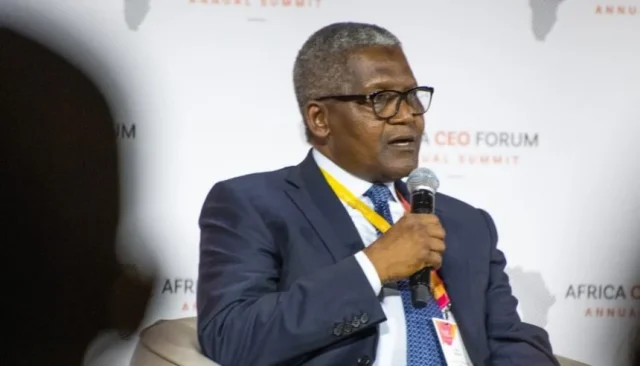
Dangote Industries Limited has acquired an additional 4,000 pieces of construction equipment as it moves ahead with plans to expand the Dangote Petroleum Refinery in Lekki to a processing capacity of 1.4 million barrels per day.
The latest acquisition brings the company’s construction equipment fleet to about 6,500 machines, according to the Group Vice President, Oil and Gas and Fertiliser, Devakumar Edwin.
Edwin disclosed this while briefing editors during a tour of the refinery complex in Ibeju-Lekki, Lagos.
He said the company had initially purchased 2,563 pieces of construction equipment after major contractors indicated they lacked the capacity to undertake some of the refinery’s main factory buildings.
“We ended up buying 2,563 pieces of equipment. We became the second largest company in the world in terms of construction equipment. Today, we are the largest because of the expansion,” Edwin said.
“We have bought 4,000 more pieces of equipment; we have 6,500 pieces of construction equipment. We bought 330 cranes.”
Dangote Opts for In-House Construction Capacity
According to Edwin, the decision to build an extensive equipment fleet followed concerns about the cost of relying heavily on foreign Engineering, Procurement and Construction contractors.
He explained that bringing overseas contractors into Nigeria would require transporting their equipment into and out of the country, with those costs ultimately incorporated into the refinery’s construction bill.
The company consequently decided to purchase its own equipment and develop the capacity to execute significant portions of the project internally.
Edwin recalled that Julius Berger reviewed the refinery’s plans but declined to construct its main process buildings due to capacity constraints.
The construction company subsequently handled 43 of approximately 127 auxiliary buildings at the refinery, including canteens, transformer rooms, control rooms and firefighting facilities.
Infrastructure Deficit Drives Investment
Edwin said Nigeria’s infrastructure deficit also influenced Dangote’s decision to invest heavily in construction machinery and supporting infrastructure.
He recalled that when the company constructed its Apapa sugar refinery in 1998, Nigeria had only two large cranes with capacities of about 150 tonnes each.
For the Lekki refinery project, Dangote hired one of only two 5,000-tonne cranes available globally at the time, while purchasing 330 cranes of its own.
Operating in an environment with significant infrastructure gaps, Edwin said, requires companies to invest in facilities and equipment that would ordinarily be readily available in more developed industrial markets.
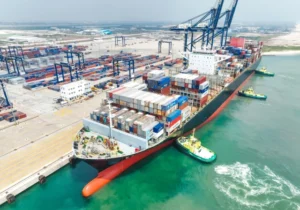
The refinery’s existing supporting infrastructure includes a granite quarry with a 10-million-tonne capacity, 82 concrete batching plants, 203 transit mixers, a private port, an oxygen and welding-gas plant, and accommodation facilities capable of housing 50,000 workers.
Much of the infrastructure developed during the refinery’s first phase will also be deployed for the planned expansion, potentially reducing the cost and construction time of the project.
Refinery Operating Above Designed Capacity
Edwin also disclosed that the refinery is currently processing about 700,000 barrels of crude oil per day, exceeding its original nameplate capacity of 650,000 barrels per day.
“We have designed the refinery for 650,000, but we are now operating at 700,000. That is over 50,000 barrels per day above the design capacity. So the production volumes are even higher,” he said.
The company plans to double the facility’s capacity to 1.4 million barrels per day as part of its next phase of expansion.
Dangote Says In-House Execution Saved Billions
Edwin said Dangote also opted to execute the refinery project through its own project company after international contractors proposed fees equivalent to about 12.5 per cent of an estimated $19.5bn capital cost.
According to him, the proposed fees would have amounted to approximately $2.5bn for design and project supervision.
The group subsequently used Dangote Projects Limited to handle detailed engineering, procurement and the engagement of contractors required to construct the refinery.
“That is how we took up the challenge, and a Nigerian company, Dangote Projects Limited, designed the detailed engineering, went for the tenders, bought every single item, even the nuts and bolts, we bought directly, and engaged contractors, and we constructed the refinery,” Edwin said.
Refining Capacity Could Reach 2.1 Million Bpd
Edwin described the Lekki facility as the world’s largest single-train petroleum refinery, noting that the largest comparable facility before its construction had a capacity of about 430,000 barrels per day.
He said the refinery was designed to serve both Nigeria’s domestic market and international customers.
According to him, about 44 per cent of its production was originally projected to meet Nigeria’s requirements, while the remaining 56 per cent was intended for export markets.
He added that approximately 95 per cent of the refinery’s output consists of higher-value petroleum products, including petrol, diesel and aviation fuel, while the remaining five per cent comprises industrial products such as carbon black feedstock.
The facility was also designed to produce Euro 5 and Euro 6-grade petroleum products and process various African crude grades alongside United States West Texas Intermediate crude.
With the proposed expansion of the Lekki refinery to 1.4 million barrels per day and plans for a separate 700,000-barrel-per-day refinery in Kenya, Dangote’s combined refining capacity could reach 2.1 million barrels per day.




Post Comment