Why Tier-1 banks’ profits declined by 18% despite strong earnings growth
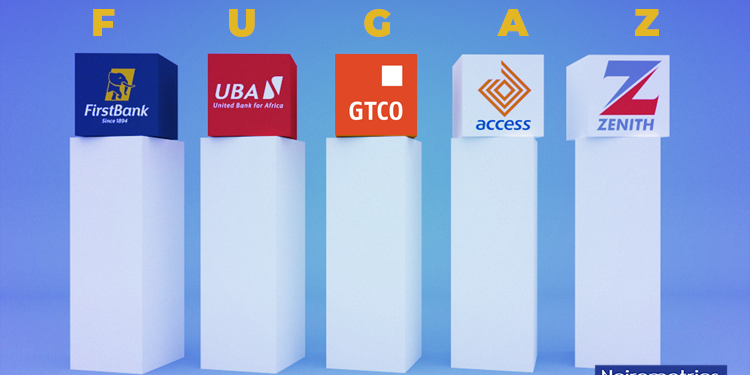
Five listed Nigerian Tier-1 banks, also known as FUGAZ have released their full-year 2025 results for the period ended December 2025, reporting a combined pre-tax profit of N4.15 trillion.
This represents a decline of about 18% from the N5.06 trillion recorded in 2024.
A review of results from Access Holdings, FirstHoldco, GTCO, UBA, and Zenith Bank shows that the decline was primarily driven by a sharp drop in net trading and foreign exchange gains, alongside a surge in impairment charges and operating expenses’
However, beneath the weaker headline, profit lies in a different story.
Strong core earnings
The banks’ core operations remained strong, with combined interest income rising by 17.66% to N14.49 trillion, up from N12.31 trillion in 2024.
- Interest income from loans and advances to customers remained the dominant driver, contributing N7.2 trillion; an 18% increase from N6.13 trillion recorded in the prior year. This accounts for roughly 50% of total interest income.
- On the other hand, the banks earned N6.21 trillion from investments in treasury bills, bonds, and other financial assets, representing a 16.8% year-on-year increase from N5.31 trillion in 2024 and accounting for about 43% of total interest income.
This highlights a narrowing gap between lending and securities income, suggesting that banks are no longer relying primarily on lending, but are increasingly allocating capital to government instruments
A closer look at individual banks shows a clear divergence in strategy. UBA and GTCO generated more income from investment in securities than from lending.
- For instance, UBA earned N1.47 trillion from securities compared to N864.5 billion from loans, while GTCO reported N789.8 billion from securities, higher than the N559.4 billion generated from lending in 2025.
In contrast, Access Holdings, FirstHoldco, and Zenith Bank continued to earn more from loans. Access recorded N1.95 trillion in loan income against N1.35 trillion from securities, while Zenith posted N1.82 trillion from loans compared to N1.64 trillion from securities, highlighting how the gap is gradually narrowing.
Shift toward securities
This trend is further reflected in asset allocation, with banks increasingly channeling funds into investment securities relative to loans.
Combined loans and advances rose modestly by 7.63% to N43.01 trillion in 2025, compared to a much stronger 23.25% growth in investment securities, which increased to N48.88 trillion.
As a result, total investment in securities now exceeds loan books, reinforcing the growing importance of government instruments such as treasury bills and bonds in banks’ balance sheets.
A closer look at individual banks shows how this shift is playing out across the industry.
- Access Holdings recorded N13.34 trillion in loans compared to N16.31 trillion in securities, highlighting a significant tilt toward investment instruments.
- Similarly, UBA’s securities portfolio stood at N14.43 trillion, more than double its loan book of N7.02 trillion, while GTCO also maintained a larger securities book of N5.54 trillion relative to N3.13 trillion in loans.
In contrast, FirstHoldco and Zenith Bank remain more lending-focused, although the gap is narrowing.
- FirstHoldco reported N9.06 trillion in loans versus N7.20 trillion in securities, while Zenith posted N10.45 trillion in loans compared to N5.41 trillion in securities.
Rising impairments factor
Despite this shift in asset allocation, credit risk across these banks continues to rise.
Impairment charges on loans and advances to customers increased significantly, with combined impairments rising by 58.73% to N2.29 trillion in 2025, compared to N1.44 trillion in 2024.
This increase may also be partly linked to the exit of regulatory forbearance directed by the Central Bank of Nigeria (CBN) last year.
- At an individual level, most of the banks recorded sharp increases in credit losses. Access Holdings saw impairments on loans and advances to customers surge by 209.19% to N287.37 billion, while FirstHoldco recorded a 91.36% increase to N710.03 billion. UBA and Zenith Bank also reported notable increases of 54.40% and 41.95% respectively.
- GTCO was the only outlier, recording a decline of 51.40% in impairment charges.
Overall, the surge in impairment charges, alongside other pressures such as weaker FX income and rising operating costs, contributed significantly to the decline in Tier-1 banks’ profitability in 2025.
Weaker FX income and higher operating expenses impact
The pressure on earnings was further compounded by a sharp decline in net trading and foreign exchange income.
- Combined FX income fell by 53% to N1.52 trillion in 2025, down from N3.22 trillion in 2024, as the windfall gains recorded in the prior year following currency devaluation did not recur.
- While Access Holdings recorded a 40.33% increase in FX income to N1.23 trillion, most other banks saw steep declines.
- FirstHoldco’s FX income dropped by 90.75% to N47.2 billion, while Zenith Bank and GTCO recorded declines of 89.71% and 51.96% respectively.
- UBA reported a net FX loss of N140.6 billion, representing a full reversal from the N181.8 billion gain recorded in 2024.
At the same time, operating expenses, including depreciation and amortization rose significantly across the board, increasing by 29.03% to N5.53 trillion in 2025 from N4.29 trillion in the prior year.
- The increase in costs was particularly pronounced for UBA and FirstHoldco, which recorded expense growth of 70.83% and 36.12% respectively.
- Zenith Bank and GTCO also recorded increases of 23.26% and 17.95% respectively, while Access Holdings maintained relatively moderate cost growth at 12.38%.
These combined contributed to the decline in profit in 2025 compared to 2024. The strong asset base and deposit growth highlight the underlying strength and stability of Tier-1 banks, positioning them to sustain growth as macroeconomic conditions evolve.
Total assets rose by 10.29% to N160.97 trillion in 2025, up from N145.95 trillion in the prior year, reflecting continued expansion in banking activities.
This growth was largely supported by strong customer deposits, which stood at a combined N114.27 trillion, underscoring sustained confidence in the banking system and providing a stable funding base for operations.














Post Comment